If you are an Indian farmer, you have probably heard about Nano Urea and Nano DAP by now. The government is promoting them aggressively. IFFCO is advertising them everywhere. Your input dealer may have even bundled one with your last fertilizer purchase.
But here is the question every farmer is actually asking:
“Does Nano Urea actually work? Should I use it on my farm this season?”
We are going to answer that question honestly — not with government press releases, not with IFFCO marketing material, but with real research, real farmer experiences, and a balanced, practical guide that helps YOU make the right decision for YOUR farm.
This is the most complete guide on Nano Urea and Nano DAP available for Indian farmers in 2026. Bookmark it.
What is Nano Urea?
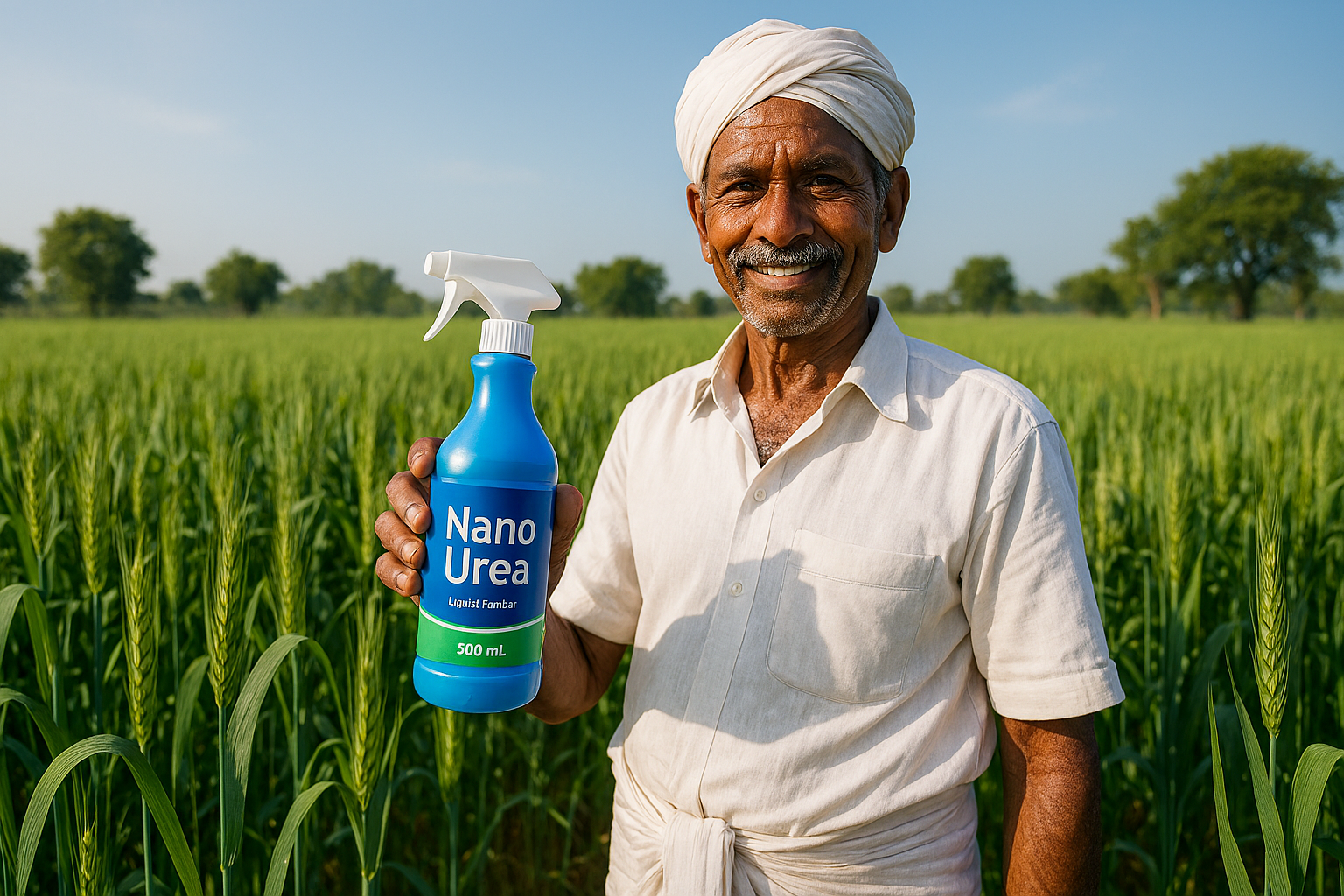
Nano Urea is a liquid nitrogen fertilizer developed by IFFCO (Indian Farmers Fertiliser Cooperative Limited) using nanotechnology. It was commercially launched in June 2021 and is the first nano fertilizer to be officially approved by the Government of India and included in the Fertilizer Control Order (FCO).
Unlike conventional urea which comes in solid prills (small white balls), Nano Urea is a liquid that you spray directly on crop leaves — a process called foliar application.
How Does It Work?
The science behind Nano Urea is about size. Regular urea prill has a size of about 1–2 mm. Nano Urea particles are just 20–50 nanometres (nm) in size — that is 10,000 times smaller than a conventional urea prill.
Because of this ultra-small size:
- Particles can enter plant leaves directly through stomata (the tiny pores on leaves)
- Nutrient absorption efficiency increases to over 80% according to IFFCO
- Less nitrogen is lost to leaching, volatilization, or runoff into the environment
One 500 ml bottle of Nano Urea contains 55,000 nitrogen particles for every 1 mm urea prill — the concentration of nitrogen delivery at the leaf level is dramatically higher than soil application.
Key Specification
| Parameter | Details |
|---|---|
| Product Type | Liquid fertilizer |
| Active Ingredient | Nano nitrogen particles |
| Nitrogen Content | 4% N (original), 8% (Super Nano), 20% (Nano Plus — latest) |
| Particle Size | 20–50 nanometres |
| Method of Application | Foliar spray (on leaves) |
| Pack Size | 500 ml bottle |
| Shelf Life | 1 year from manufacturing date |
| Approved by | Government of India (FCO approved) |
| Developed by | IFFCO Nano Biotechnology Research Centre (NBRC) |
What is Nano DAP?
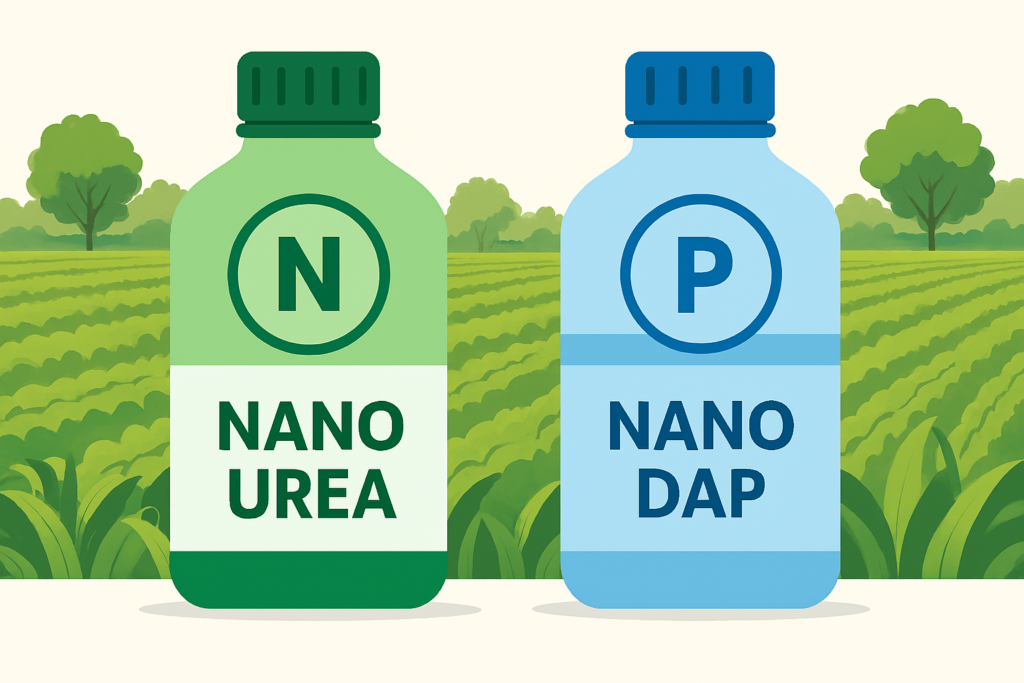
Nano DAP (Nano Di-Ammonium Phosphate) is the second major nano fertilizer from IFFCO, officially launched on April 26, 2023 by Union Home Minister Amit Shah. Like Nano Urea, it is nanotechnology-based but provides TWO nutrients — nitrogen AND phosphorus.
How is Nano DAP Different from Nano Urea?
While Nano Urea only provides nitrogen, Nano DAP provides both nitrogen (N) and phosphorus (P) — making it a more complete nutrient solution, especially during the early growth stages of crops.
Key Specification
| Parameter | Details |
|---|---|
| Product Type | Liquid fertilizer |
| Nutrients | Nitrogen (8% N w/v) + Phosphorus (16% P₂O₅ w/v) |
| Particle Size | Less than 100 nanometres |
| Method of Application | Seed treatment + Foliar spray |
| Pack Size | 500 ml bottle |
| Approved by | Government of India (FCO approved) |
| Manufacturers | IFFCO, Coromandel International, Zuari Farm Hub |
Nano Urea vs Nano DAP vs Conventional Fertilizers — Complete Comparison
This table is what no other website has compiled for Indian farmers — a full side-by-side comparison of all four options:
| Feature | Conventional Urea | Nano Urea (IFFCO) | Conventional DAP | Nano DAP (IFFCO) |
|---|---|---|---|---|
| Nutrients provided | Nitrogen (46% N) | Nitrogen (4–20% N) | N + P (18% N, 46% P) | N + P (8% N, 16% P) |
| Form | Solid prill | Liquid | Solid granule | Liquid |
| Application method | Soil broadcasting | Foliar spray | Soil application | Seed treatment + foliar |
| Price (2026) | ₹265–₹270/bag (45 kg) | ₹225–₹250/500ml bottle | ₹1,350/bag (50 kg) | ₹600–₹650/500ml bottle |
| Nutrient use efficiency | 30–50% | 80%+ (claimed) | 20–25% | Higher (claimed) |
| Labour requirement | Low | High (spraying needed) | Low | Medium |
| Environmental impact | High (leaching, emissions) | Lower | High | Lower |
| Risk of yield loss | Low (well-established) | Medium–High (mixed research) | Low | Medium (mixed research) |
| Govt. subsidy | Yes (heavily subsidized) | No | Yes (subsidized) | No |
| Best for | Basal + top dressing | Top dressing supplement | Basal application | Seed treatment supplement |
| Shelf life | 2+ years | 1 year | 2+ years | 2 years |
| Research backed | Decades of data | Mixed/controversial | Decades of data | Mixed/early stage |
Price & Where to Buy Nano Urea and Nano DAP in 2026
Current Price (2026)
| Product | Pack Size | Price |
|---|---|---|
| IFFCO Nano Urea (Liquid) | 500 ml | ₹225–₹250 |
| IFFCO Nano DAP (Liquid) | 500 ml | ₹600–₹650 |
| Conventional Urea | 45 kg bag | ₹265–₹270 |
| Conventional DAP | 50 kg bag | ₹1,350 |
Important note on price comparison: While Nano Urea appears cheaper than a bag of urea (₹250 vs ₹265), remember that you need at least 2 bottles per acre per application, plus the cost of spraying labour. The true cost per acre is significantly higher than conventional urea when labour is included.
Where to Buy
Offline (Recommended for authenticity):
- IFFCO member cooperative societies (PACS) in your district
- Pradhan Mantri Kisan Samruddhi Kendras (PMKSKs)
- IFFCO Bazar outlets across India
- Authorised agri-input retailers
Online:
- iffcobazar.in — official IFFCO online store
- BharatAgri (bharatagri.com) — free delivery, COD available
- BigHaat (bighaat.com) — pan-India delivery
- Amazon.in — available from authorised sellers
How to check authenticity:
- Labels on genuine bottles cannot be peeled off (in-mould labels)
- IFFCO logo should be on the cap
- Bottle should be properly sealed and not tampered
- Check manufacturing date — use within 1 year for Nano Urea, 2 years for Nano DAP
How to Use Nano Urea — Complete Dosage Guide
This is where most articles fail farmers — they give vague instructions. Here is the exact, step-by-step guide.
General Dosage Rule
Mix 2 to 4 ml of Nano Urea per 1 litre of water. For one acre, you need approximately 125 litres of water — meaning 1 bottle (500 ml) of Nano Urea per acre per spray.
When to Spray
- 1st Spray: At active tillering or branching stage — 30 to 35 days after germination, or 20 to 25 days after transplanting
- 2nd Spray: 20 to 25 days after the 1st spray, or just before flowering
Crop-Wise Dosage Chart
| Crop | Dosage | Spray Timing | No. of Sprays |
|---|---|---|---|
| Wheat | 2–4 ml/litre | Tillering + Pre-heading | 2 |
| Rice/Paddy | 2–4 ml/litre | Tillering + Panicle initiation | 2 |
| Maize | 2–4 ml/litre | Knee-high + Tasselling | 2 |
| Sugarcane | 2–4 ml/litre | Tillering + Grand growth | 2 |
| Cotton | 2–4 ml/litre | Branching + Boll formation | 2 |
| Soybean | 2–4 ml/litre | Branching + Pod filling | 2 |
| Groundnut | 2–4 ml/litre | Branching + Pegging | 2 |
| Onion | 2–4 ml/litre | Bulb initiation | 1–2 |
| Tomato | 2–4 ml/litre | Flowering + Fruiting | 2 |
| Mustard | 2–4 ml/litre | Branching + Flowering | 2 |
| Gram/Chana | 2–4 ml/litre | Branching + Pod formation | 2 |
Nano DAP Dosage
Seed Treatment: 3 to 5 ml per kg of seeds — dissolve in water to form a thin film on seed surface before sowing.
Foliar Spray: 2 to 4 ml per litre of water at good foliage stage (tillering/branching) and a 2nd spray at pre-flowering stage.
Important Spraying Tips
✅ Always spray in the morning or evening — avoid afternoon spraying as heat causes rapid evaporation and reduces absorption
✅ Use a flat fan nozzle or cut nozzle — ensures fine, even coverage on leaves
✅ If rain occurs within 12 hours of spraying — repeat the application as nutrients get washed off
✅ Do a jar test first before mixing with other agrochemicals — not all chemicals are compatible
✅ Nano Urea CAN be mixed with: Biostimulants, 100% water-soluble fertilizers, most agrochemicals (after jar test)
❌ Do NOT spray during peak sunlight hours
❌ Do NOT use after the expiry date — efficacy drops significantly
❌ Nano Urea CANNOT replace basal urea — it only works as a top-dressing supplement via foliar application
Benefits of Nano Urea — With Real Data

Here are the genuine, documented benefits of Nano Urea based on IFFCO’s own field trials and research:
1. Higher Nutrient Use Efficiency
Conventional urea applied to soil has a nitrogen use efficiency of only 30–50% — more than half the nitrogen is lost through leaching, volatilization, and runoff. Nano Urea applied as a foliar spray delivers nitrogen at over 80% efficiency directly to plant cells through leaf stomata.
2. Potential Yield Increase
IFFCO reports an average yield increase of up to 8% based on 11,000 field trials conducted across India between 2019 and 2020. Some crops showed higher improvements under specific conditions.
3. Reduces Conventional Urea Requirement
A single bottle of Nano Urea (500 ml) is recommended to replace one 45 kg bag of conventional urea for top-dressing. This can reduce conventional urea consumption by up to 50% when used as directed.
4. Environmental Benefits
- Reduces nitrogen leaching into groundwater
- Lowers greenhouse gas emissions from fields
- Two foliar sprays of nano-urea have been shown to curtail nitrogen load by 25%
- Less soil pollution compared to conventional urea overuse
5. Farmer Income Benefit
IFFCO claims farmers can earn up to ₹2,000 more per acre due to improved yield and reduced input costs — though this figure varies significantly based on crop, location, and farming practice.
6. Easy Storage and Handling
One 500 ml bottle replaces a 45 kg bag — dramatically easier to transport, store, and handle, especially for small and marginal farmers.
Disadvantages of Nano Urea — What IFFCO Won’t Tell You
This section is what most other articles skip. At Krushimantri, we believe farmers deserve the complete picture — including the problems.
1. High Labour Cost for Spraying
This is the most significant practical problem. Unlike conventional urea which can be broadcast by one farmer, Nano Urea requires spraying equipment and trained labour.
According to soil scientists, spraying Nano Urea on one acre requires:
- At least 3 to 5 labourers
- Additional cost of approximately ₹1,500 to ₹2,000 per acre in labour
When this is added to the cost of 2 bottles (₹500), the total cost per acre for Nano Urea top-dressing is ₹2,000 to ₹2,500 — significantly more than conventional urea.
2. Cannot Replace Basal Urea Application
This is a critical misunderstanding. Nano Urea cannot replace the soil-applied basal dose of nitrogen that crops need in the early growth stage. It can only supplement or replace the top-dressing dose. Many farmers who tried to completely replace conventional urea with Nano Urea saw crop failure.
3. Weather Dependency
Rain within 12 hours of spraying means the application is wasted and must be repeated. In monsoon-dependent farming regions of India, this creates significant practical challenges and unpredictable costs.
4. Short Shelf Life
Nano Urea must be used within 1 year of the manufacturing date. If purchased and stored beyond this period, effectiveness drops significantly — an issue for farmers in remote areas with limited access to fresh stock.
5. Forced Tagging Controversy
In 2025, the government had to issue specific orders to stop retailers from bundling (tagging) Nano Urea with conventional fertilizer purchases — meaning farmers were being forced to buy Nano Urea to get their regular DAP or urea. This practice was declared a malpractice and action was directed against offenders. This controversy reveals that demand for Nano Urea has not been as strong as government targets suggest.
6. Mixed Results on Different Soil Types
Nano Urea’s effectiveness varies significantly depending on soil type, climate zone, crop variety, and farming practices. Results in black soil regions differ from results in red or alluvial soil areas.
PAU Research Findings — The Controversial Truth
The most important and widely discussed research on Nano Urea comes from Punjab Agricultural University (PAU) — one of India’s most respected agricultural universities.
What PAU Found on Nano Urea (Wheat and Rice):
A two-year field experiment conducted by Dr. Rajeev Sikka (Principal Soil Chemist) and Dr. Anu Kalia (Nanotechnology Scientist) at PAU found:
- 21.6% decrease in wheat yield when Nano Urea was used instead of conventional urea
- 13% decrease in rice yield compared to conventional nitrogen fertilizer application
- Decline in grain nitrogen content — affecting protein quality
- Above-ground tiller biomass and root volume were reduced after Nano Urea application
- The magnitude of yield reduction increased in the second year — suggesting the problem gets worse over time, not better
What PAU Found on Nano DAP (Wheat):
A separate two-year PAU study on Nano DAP found:
- 16.1% decline in wheat grain yield with two sprays of Nano DAP and zero conventional DAP
- Reduction in nitrogen and phosphorus uptake by the plant
- Plant height reduced compared to conventional DAP plots
IFFCO’s Response
IFFCO has contested these findings, pointing to their own 11,000 field trials showing positive results. The company argues that the PAU trials may not reflect conditions across all agro-climatic zones of India.
International Research Perspective
An opinion paper published in the journal Plant and Soil by researchers from the University of Copenhagen found that Nano Urea has “no or poor scientifically proven effects” and warned that IFFCO’s claims “may lead to large-scale yield losses with serious consequences for food security.”
However, a 2025 study published in Frontiers in Nanotechnology by ICAR-Central Research Institute for Dryland Agriculture (CRIDA) showed that integrating Nano Urea with 75% of the conventional recommended dose of nitrogen in rainfed maize delivered comparable yields to the full conventional dose — while reducing greenhouse gas emissions.
What This Means for Farmers
The research picture is mixed. The honest conclusion is:
- Nano Urea as a complete replacement for conventional urea is not supported by independent research
- Nano Urea as a supplement to 75% conventional urea shows promise in some crops, particularly maize
- More long-term field research is needed across different crops and agro-climatic zones
- Farmers should not switch entirely to Nano Urea based on current evidence
Which Crops is Nano Urea Best For?
Based on available field trial data and research, here is an honest assessment:
✅ Shows Positive Results:
- Maize (Rainfed) — ICAR-CRIDA research shows good results when combined with 75% conventional fertilizer
- Vegetables (Tomato, Onion, Chilli) — Multiple positive field trials reported
- Sugarcane — Positive results in Maharashtra and UP field trials
- Pulses (Soybean, Gram) — Generally positive response to foliar nitrogen
⚠️ Mixed or Neutral Results:
- Cotton — Variable results depending on region and soil type
- Groundnut — Limited data available
- Mustard — Some positive trials but inconsistent
❌ Shows Negative Results in Research:
- Wheat — PAU field experiments show 21.6% yield decline
- Rice/Paddy — PAU field experiments show 13% yield decline
- Wheat-Rice cropping system — Concerns about cumulative year-on-year decline
State-Wise Availability Guide
Nano Urea and Nano DAP are available across India through different channels:
| State/Region | Primary Availability | Online Option |
|---|---|---|
| Punjab & Haryana | PACS, IFFCO Bazar outlets | iffcobazar.in |
| Uttar Pradesh | PMKSKs, PACS, cooperative societies | BharatAgri, BigHaat |
| Maharashtra | District cooperative banks, PACS | iffcobazar.in, BharatAgri |
| Andhra Pradesh & Telangana | PACS, agri-input retailers | BigHaat, BharatAgri |
| Karnataka | PACS, KVK distribution centres | BigHaat |
| Gujarat | IFFCO Bazar, cooperative societies | iffcobazar.in |
| Madhya Pradesh | PACS, PMKSKs | BharatAgri |
| Rajasthan | Cooperative societies, PACS | iffcobazar.in |
| Bihar | PACS, district cooperative outlets | BharatAgri |
| West Bengal | Cooperative societies | BharatAgri |
Pro Tip: Always buy Nano Urea from PACS or official IFFCO Bazar outlets to ensure authenticity. Fake products have been reported in some markets.
Is Nano Urea Right for You? Honest Verdict
Use this simple checklist to decide:
✅ Consider Using Nano Urea IF:
- You grow maize, vegetables, sugarcane, or pulses
- You want to reduce conventional urea by 25–50% (not replace it completely)
- You have reliable spraying equipment and labour available
- Your farm does NOT depend on monsoon rains during critical growth stages
- You are interested in reducing environmental impact of farming
❌ Avoid Nano Urea or Use With Caution IF:
- You grow wheat or rice as your primary crop
- You are planning to completely replace conventional urea with Nano Urea
- You have no access to spraying equipment or face high labour costs
- Your region receives frequent monsoon rains during the crop season
- You are looking for a tried-and-tested solution with decades of data
Our Honest Recommendation:
Do not completely replace conventional urea with Nano Urea. The research does not support this, particularly for wheat and rice farmers. However, using Nano Urea as a supplement at 25–33% of your conventional top-dressing dose for crops like maize, vegetables, and sugarcane is worth experimenting with — especially if you can monitor results season by season.
Start with a small trial plot — apply Nano Urea on half your field and conventional urea on the other half. Compare results at harvest. Let your own land give you the answer.
Frequently Asked Questions (FAQ)
Q: Can I use Nano Urea with pesticides? Yes, but always do a jar test first. Mix a small quantity of Nano Urea with the pesticide in a jar, shake, and observe for any reaction (settling, clumping, colour change). If no reaction after 30 minutes, it is safe to mix.
Q: What if it rains immediately after I spray Nano Urea? If rain falls within 12 hours of spraying, the application should be repeated. The nitrogen washes off before being absorbed by the leaves.
Q: Can I replace ALL conventional urea with Nano Urea? No — this is a common and dangerous misconception. Nano Urea can only replace the top-dressing component, not the basal dose. Completely replacing conventional urea has led to significant yield losses in research trials.
Q: Is Nano Urea safe to handle? Yes, it is declared safe for users, flora, and fauna. However, wear a face mask and gloves while spraying as a general precaution.
Q: Is Nano Urea suitable for organic farming? No. Nano Urea is a synthetic nitrogen product and is not certified for organic farming.
Q: How do I store Nano Urea properly? Store in a cool, dry place away from direct sunlight and high temperatures. Keep out of reach of children and pets. Use within 1 year of manufacturing date.
Q: Why is my dealer insisting I buy Nano Urea with my regular urea or DAP? This is called “tagging” and it is illegal. The government issued orders in 2025 to stop this practice. You have the right to buy conventional fertilizers without purchasing Nano Urea. Report forced tagging to your District Agriculture Officer.
Q: Is there a government subsidy on Nano Urea? No. Unlike conventional urea and DAP which are heavily subsidized, Nano Urea currently has no subsidy. You pay the full market price.
Q: Can I get Nano Urea through PM Kisan Samruddhi Kendras? Yes, Nano Urea is distributed through PMKSKs across India. Contact your nearest centre for availability.
Q: What is the difference between Nano Urea and Nano Urea Plus? IFFCO has evolved the product multiple times. The original Nano Urea had 4% nitrogen. “Super Nano” had 8%. The latest version, Nano Urea Plus, claims 20% nitrogen concentration and was launched in 2024–25. Each version was developed to address limitations of the previous one.
Conclusion
Nano Urea and Nano DAP represent a genuine step forward in agricultural technology — the science of nanotechnology is real and the potential is significant. However, the current state of independent research suggests that these products are not ready to replace conventional fertilizers for all crops and all situations.
The wisest approach for Indian farmers in 2026 is to:
- Continue with conventional urea and DAP as your primary fertilizer
- Trial Nano Urea on a small plot if you grow maize, vegetables, or sugarcane
- Never completely eliminate conventional basal fertilizer based on Nano Urea marketing claims
- Monitor your own results season by season and make data-driven decisions
- Refuse forced bundling — you have the legal right to buy conventional fertilizers separately
Agriculture is your livelihood. Make decisions based on your own land, your own results, and trusted research — not just government targets or company marketing.